Oil and gaslighting: End profiteering and defend jobs!

War in Iran has put energy profiteering back in the headlines. Rather than seizing this moment, Sharon Graham has allowed our union to be co-opted by the most reactionary forces attacking our members. This repeats a disastrous industrial and political approach which has failed to stop major site closures. We need to reunite - to end energy profiteering, prevent disastrous site closures, and give real support to oil and gas members.
Profiteering and political posturing:
A government hardly known for its radicalism has come out against profiteering, with Rachel Reeves “warning” petrol retailers and energy suppliers against price gouging.
Taking on profiteering – especially energy profiteering – was one of the major priorities of our union, but now Unite’s voice is entirely missing just when we could be pushing the government to go further.
Instead, a statement from Sharon Graham spoke of the “political self-harm” of not allowing new drilling in the North Sea. This was eagerly pushed by Conservative Party Headquarters, and Tory Shadow Minister Claire Coutinho, who used it as evidence that our union supports their position as they fight back against attempts to reign in profiteering. Bizarrely the Daily Mail piece co-opting Graham’s quote for the Tory agenda was then promoted by ‘Unite for A Workers’ Economy,’ doubling down on the position.
An early promise of Graham’s political approach was not to be constrained to only talking to the union’s traditional allies on the Labour Left. (A strategy since taken to the point of not convening meetings of the Unite sponsored MPs group in years.)
In 2020 Tory MP Huw Merriman was the most high-profile supporter of Graham’s campaign to stop 'fire and re-hire' at British Airways. More controversially, in 2014 Graham’s failed NHS campaign followed the blind alley of lobbying UKIP while also vainly dispatching Organisers from across Scotland to lobby the nation’s only Tory MP in Dumfriesshire.
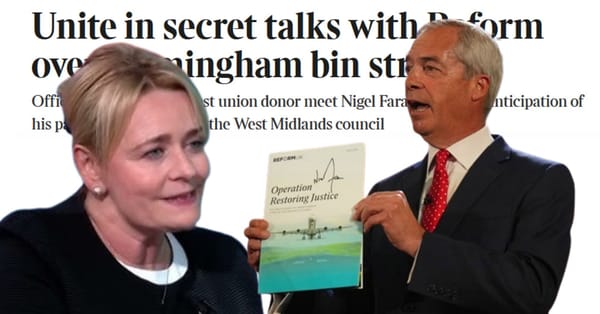
This approach is taken to its final conclusion with Sharon Graham’s promise to ‘talk to the devil himself’ when asked by Sky News if she would talk to Nigel Farage.
If politicians can be used by the union to defend workers, then so they should be. Jobs come beyond political purity. The problem is this has not worked. Sites have closed. Jobs have been lost. This strategy has failed. The closure of Grangemouth Refinery has been followed by the job losses at Lindsey, both following thousands of job losses at Port Talbot steelworks and the Stellantis van plant in Luton.
The second problem is: Who is using who? When Conservative Party HQ, Reform, the Daily Mail and the fossil fuel lobbyists quote Sharon Graham they do so not to advance our cause but theirs. In this case these reactionary forces are lobbying to remove the windfall tax on oil and gas, prevent action against profiteering, and allow more profiteering. They could not give a damn about a single worker in the oil and gas industry.
Notably, the only two successful campaigns to save sites from closure during Graham’s tenue are Scunthorpe steelworks and Alexander Dennis bus builders in Scotland, neither of which involved Sharon Graham. Both succeeded when reps used industrial unity to strengthen political engagement and move two different governments into action.
The North Sea and the need for new work:
Regarding the need for a transition for the North Sea oil fields, one of Sharon Graham’s routine phrases is: “We cannot let go of one rope before we have hold of another.”
This analogy does not work if the first rope is no longer attached to anything. The eventual decline of North Sea energy is a geological fact, evidenced by BP and Shell reducing their presence in the North Sea fields and passing them to smaller firms.
The priority is marshalling our industrial and political strength to save the maximum number of jobs and win the investment for new jobs to replace work being phased out. This problem is not unique to oil and gas workers. It is shared with workers across steel and wider manufacturing.
Promises of new jobs cannot be fantasies and neither can the plans to deliver them. This was one of the most important points made by the ‘Keep Grangemouth Working’ campaign, which tore into the stark limitations of Keir Starmer’s claim of investing £200 million into Grangemouth which has not materialised.
Infuriatingly, this important point and the demand ‘no ban without a plan’ is completely undermined when Graham refuses to publish her own plan! As the parliamentary report into the closure of Grangemouth concluded:
“When we requested a copy of the plan after the session, we received no response. We followed up with three letters requesting sight of the energy transition plan, twice to Mr Thomson and then to Unite’s General Secretary Sharon Graham. No response has so far been received.”
“Given what is at stake if transition is mismanaged, we are disappointed that Unite the Union has been unable to share, as promised, its plan to create 35,000 energy transition jobs. The plan might have been a valuable and timely contribution to our inquiry and could have assisted us in developing our recommendations to the Government while it develops its own North Sea transition plan. Unite’s clear failure to supply the plan ultimately casts doubt over its existence.” (Source.)
Workers need substance over performance. A real plan must chart exactly how jobs can be defended and the investment needed to create new jobs utilising the same skills with like-for-like union pay and conditions as a minimum.
The truth is only serious investment in renewable energy can make the UK less exposed to global shocks to oil and gas prices and less dependent on imports from dictatorships abroad. Likewise, North Sea oil is exported to the international market which controls prices, meaning new drilling has no direct link to lowering UK energy bills. New union-organised jobs in renewable energy would deliver all of this. Major investments in new sustainable fuel plants to service the aviation and maritime sectors in the USA and Europe show what is real and possible.
Defending workers in the North Sea and oil and gas industry more broadly is one of the biggest industrial challenges in a generation. The answer is not to duck the difficulties or use them to court attention in the Daily Mail. We can only take them on – and give our members the solidarity and support they need – if we are united.
For jobs.
For the environment.
It’s time to Reunite.