Refineries in crisis: Why were workers’ warnings unheeded?
As the UK’s refineries face the existential crisis refinery workers themselves warned was coming, why did those warnings go unheeded?
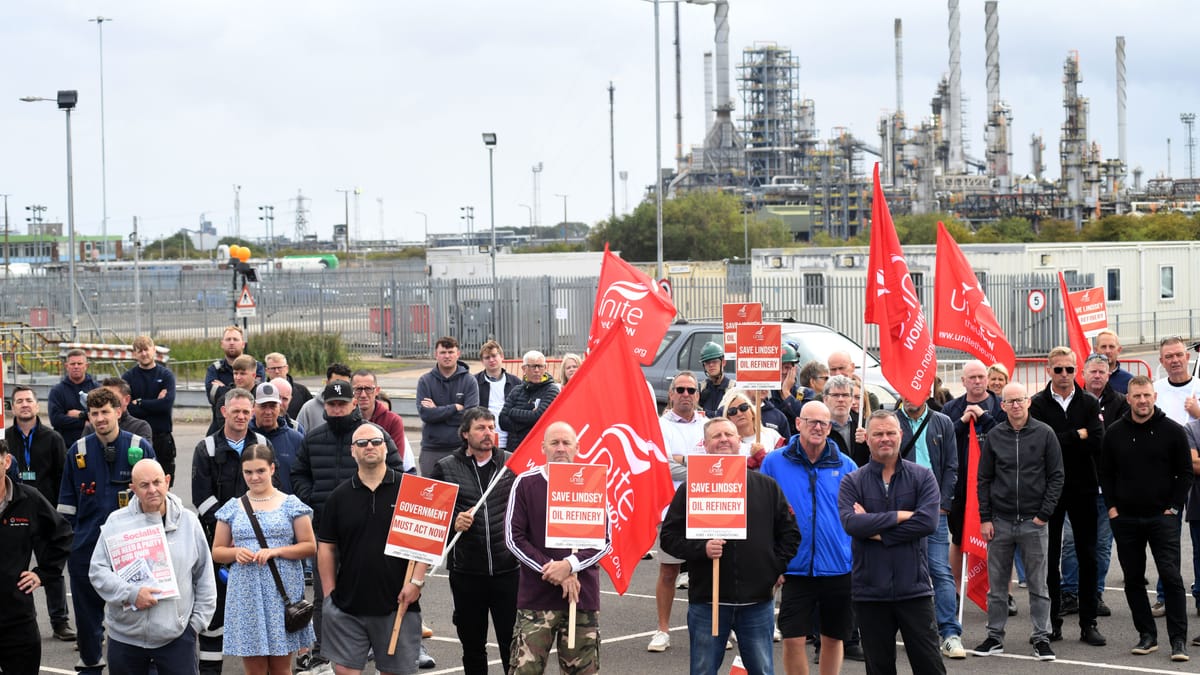
The news of redundancies at Lindsey Refinery in Lincolnshire is the devastating result of industrial failure. Production ended in August when the Prax Group collapsed into administration. Union reps on the ground have been calling for government support to prevent job losses while bids for the site remain on the table.
Lindsey isn't alone. In April the 100-year old refinery at Grangemouth stopped production, taking with it over 400 direct jobs, with a knock-on impact to 2,000 more.
The campaign to save Lindsey continues, but even beyond the closures, workers across the UK’s other refineries from Stanlow to Fawley and Pembroke have all taken official or unofficial strike action in recent years. Why were workers’ warnings ignored?
In 2012 Unite’s oil & gas reps came together at a special conference at the union’s Esher education centre in Surrey to reflect on the devastating closure of the Coryton refinery near London.
As Workers Uniting reported at the time, Unite shop stewards represented workers at BP, Conoco Phillips, Ineos, Esso Fawley, Total, Essar Stanlow, Petroplus and Valero. The meeting included Unite Assistant General Secretaries and National Officers and was supported by the Director of Unite’s International Department Simon Dubbins. Representatives from the German chemical union IG BCE and North American USW joined the conference, as well as Tom Greatrex MP, then Labour's Shadow Minister for the sector.
Closure had come suddenly to Coryton, which had supplied fuel to London and the South East, but had been sold by BP to Petroplus Holdings in 2007. The new Swiss owners "remortgaged" their sites, but loaded all the debt onto Coryton refinery alone. Despite all assurances, the parent company soon declared insolvency and consultants PwC were brought in to administer the industrial last rites. 850 jobs were lost when refining operations ended in June 2012 and the site was sold for use as a storage terminal for fuel imports.
Gathered in Esher, the Unite reps and their allies developed their strategy 'Refining our Future.' It is not only a clear sighted analysis of their industry’s problems, but also a prescient warning of what was to face them in the years ahead.
The strategy considered several questions, from market demand to energy security and industrial strategy. Most importantly, the oil and gas reps made no attempt to duck the environmental question which hung over any discussion of their industry’s future. They argued that EU emission regulations should be extended to other nations in order to ‘level the playing field’ against cheaper fuel imports from non-compliant nations, and they made the case for a just transition:
“It is clear that the impact of environmental transition on employment will vary between sectors, with energy-intensive, and heavier, more traditional, industries being hardest hit. It is in these high energy companies – such as oil refineries - that the solutions for a sustainable future must be found, and it is crucial that solutions are found that not only make a difference to the environment but also benefit workers and society through the creation of sustainable jobs."
"If this transition is not handled correctly it risks being used as an excuse for cost and job cutting or becomes nothing more than a vehicle for exporting jobs abroad."
"The concept of a ‘just transition’ is one in which the costs and benefits of decisions made in the public interest – including those necessary to protect the climate – should be shared fairly and progressively. (Refining our Future P.11)”
The reps used 'Refining our Future' to lobby industry bodies and secured buy-in from Labour Shadow Ministers under the leadership of Ed Miliband and then Jeremy Corbyn. As the years past and both governments and union leadership changed, the sector continued pushed on for its demand of a sustainable industry and a just transition that defends job. Workers continued to warn us of what was coming.
A decade on, their warnings are vindicated and history has been repeated. At Lindsey an ownership model of debt-fuelled growth has caused a ‘house of cards’ financial collapse. In Grangemouth Petroineos has turned the site into an import terminal. The only people who do not claim to be shocked by this are oil and gas workers themselves. Indeed, they have been warning about it for ten years.
The refinery workers are not alone. For years the UK’s steelworks have been starved of investment and passed between fly-by-night owners from Greybull to Liberty. When the light died in the blast furnaces and coking ovens of Port Talbot in 2023 it was not out of the blue. Like the refinery workers, steelworkers had been suffering their own decade-long crisis, which began with the closure of Redcar steelworks in 2015.
As the refinery workers noted in 2012, the ongoing problem has been the “total abdication of UK Governments of their responsibility to support and develop the country’s industrial base.” Finally, in 2025 the Labour government has published an Industrial Strategy which, while welcomed as a long overdue step, did nothing to prevent the closure of Grangemouth or the collapse of Lindsey. There is still time for government to act and save jobs in Lincolnshire, but they must also commit to working alongside union reps in our remaining refineries and finally take their experiences, their ideas and their warnings seriously.
There is also more for our union to do. From Port Talbot to Grangemouth recent years have been devastating. Last September the BBC reported the loss of 6,000 steel and oil jobs. While an 11th hour government intervention prevented the closure of British Steel in Scunthorpe, the manufacturing casualty list has been added to by Vauxhall, Schaeffler, SABIC and DS Smith.
Our union needs to return to the ambition of 'Refining our Future'. We must be able to analyse disastrous closures like Coryton or Grangemouth, learn from them and support reps and shop stewards to prevent them happening again.
Our own union needs an industrial strategy focused on supporting reps to secure the future of their sites. This is especially true for industries which we all know are energy intensive or high carbon and will need genuine just transition strategies to prevent decarbonisation from meaning jobs cuts and offshoring. That of course requires workplace and sector-level plans to be combined with a deep industrial understanding and a political strategy which can genuinely move government into action.
That cannot mean turning our back on the climate crisis or following the Tories who are now demanding attempts to meet that crisis are dismantled. It means making sure our union is central to those strategies because without unions organising to win it there can be no just transition.
It's time to listen to our workplace leaders again.
It’s time for ambitious strategies which look to the future.
It’s time to reunite and fight for a future for manufacturing and energy jobs.