An injury to all: Reunite to defend internationalism
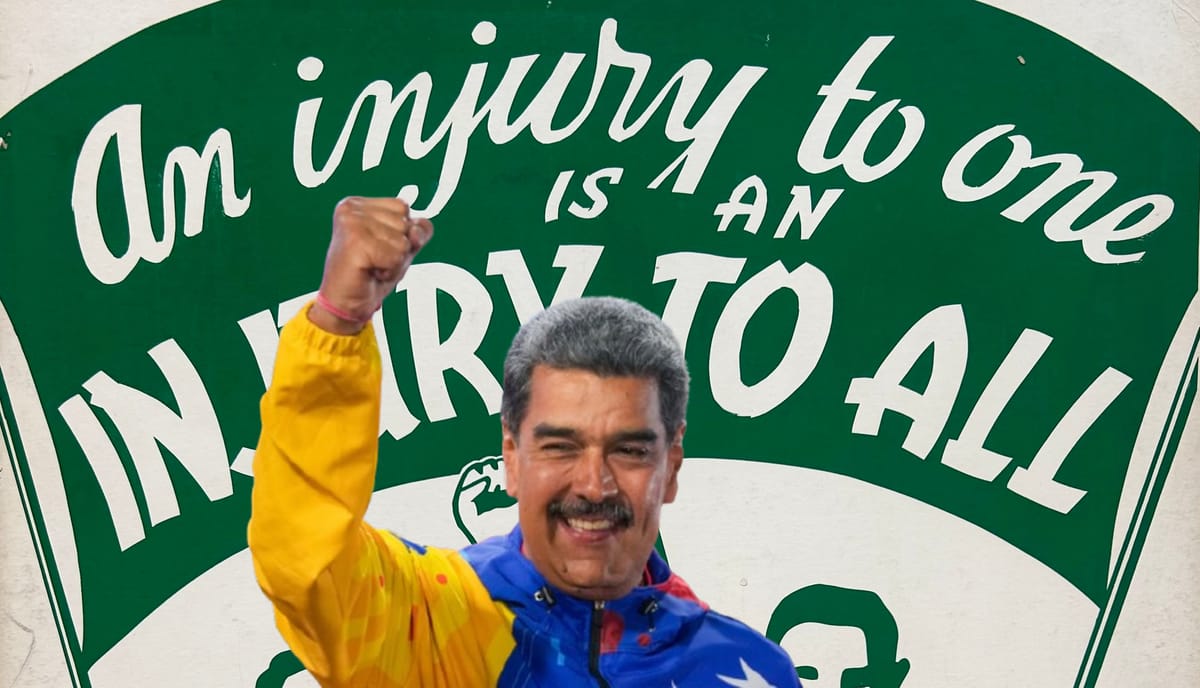
The US attack on Venezuela on January 3rd was shock and awe for the social media age – with air strikes followed by the online parading of abducted President Nicolas Maduro by Donald Trump. The trade union movement globally has condemned the attack and also the political message it sent – an assertion of far right authoritarian power we are all supposed to bow down to. Industrially and politically, it has never been more important to defend our union’s internationalism.
Unite’s leadership shared the TUC statement (oddly trying to pass it off as an original by putting 'Unite' at the top); however, the union stopped short of issuing a statement on behalf of our own members. It is likely the issue fell foul of the central governing principle which guides those at top of our union: If Sharon Graham doesn’t know about it, it cannot be important.
It is important. Venezuela. Gaza. Ukraine. All could be dismissed as far away countries of which we know little, but such a narrow view is self-defeating. ‘Trade unionism in one country’ is not an organising strategy. It ignores that the majority of our members are employed by multinationals. It also ignores the international industrial and political forces which directly shape the conditions faced by our reps and members in the workplace daily.
Take the investment and closure decisions made in Beijing, Paris and Mumbai. Take the cyberattack on JLR and our major airports. Take the funding going into UK defence industries (and where it is actually going) as well as cuts to international aid work. You may try and ignore the world, but the world will not ignore the rest of us.
Unite and Venezuela:
Our union, and its predecessors, have a long history of solidarity with the people and trade unions of Venezuela. T&G and AMICUS attended the visit of Hugo Chavez to the TUC in 2006. Recent Unite Assistant General Secretary Gail Cartmail took part in a multi-union delegation which later met with Chavez in Caracus. This was followed by Unite's International Director Simon Dubbins meeting with Nicolas Maduro, then Foreign Minister, in a subsequent visit to London.
Unite has fully supported the Bolivarian revolution with several subsequent delegations to the country, building direct links with workers in the same multinational companies that our union organises in the UK, as well as newly established workers’ cooperatives.
Unite welcomed the support that Venezuela began to provide to Cuba and other progressive governments in the region - then including Bolivia, Ecuador, Nicaragua and Brazil. The emergence of these left governments was seen as a welcome attempt to try and put public ownership and democratic governance of the economy back on the international agenda.
The cooperation between these countries was an example of concrete solidarity to hold up, such as Cuba's programme of supplying doctors and medical expertise to Left governments like Venezuela which were working to establish new health care systems.
Unite has sent delegations of reps to Cuba (and still does), Venezuela, Bolivia, Ecuador, Mexico and Nicaragua, and is affiliated to the solidarity campaigns of Cuba, Venezuela, Nicaragua and Mexico.
An injury to all:
As the example of South America shows, Unite’s history stretches back further than August 2021. An international focus has always been central to who we are.
As an early leader of the engineering and transport unions which would later form AMICUS and the T&G, Tom Mann has the best claim to being the founding father of our union. International work was central to how Mann understood trade unionism. Mann took the mantra of his age that ‘an injury to one is an injury to all’ to truly mean all of us.
That tradition continued a generation later when Jack Jones fought in the Spanish Civil War. As a union activist and then General Secretary Jones took part in numerous delegations to Yugoslavia, the USSR, the US and South America, opposed UK participation in the Vietnam war and argued directly with President Richard Nixon during a state visit in 1969. In more recent years, both AMICUS and the T&G were pillars of the international campaign against apartheid in South Africa, while Unite co-GS Tony Woodley was one of the most prominent trade union supporters of the campaign to release the Miami 5 political prisoners.
Since Unite was formed, our reps and members have been at the forefront of international solidarity work, from Palestine, to Kurdistan and Colombia. Industrially Unite reps have built relationships with trade unions around the world, which we lean on and strengthen daily through practical industrial solidarity when facing major disputes. Unite reps have supported picket lines in Scandinavia against Tesla and in turn hosted protests at the London headquarters of global mining giants. Such work has built Unite’s reputation in our global movement.
Trump and the global far right:
Since 2023 the genocide in Gaza has been the most desperate and urgent of international issues. Pressure from reps and delegates at our union’s conference moved the bureaucratic leadership to finally recognise and recommit to our union’s long existing solidarity policies (despite having spent years attacking individuals within our union who have carried out those same polices.) Gaza is not only a moral or a political issue. It has a direct industrial repercussion on Unite members, from protests outside manufacturing plants to aid workers facing the same airstrikes as those they are trying to help. Likewise, the assault on Venezuela is part of a bigger picture which will absolutely impact Unite members at work and at home.
Donald Trump is one part of a global far right and authoritarian movement alongside Javier Milei of Argentina, Viktor Orban in Hungary, Benjamin Netanyahu in Israel and indeed Vladimir Putin in Russia. Behind them stand those seeking power closer to home from Marine Le Pen and Alice Weidel in France and Germany, to Nigel Farage and Tommy Robinson in the UK.
Their nationalist agendas may clash and their stances on individual issues may differ from time to time, but each represents reaction and the unchecked power of billionaires and tech giants. All are seeking or consolidating power by clawing back social progress and whipping up racism, sexism, homophobia and transphobia. That of course includes attacking trade unions and our members. The result, as we are already seeing, is social and industrial catastrophe.
Many of the statements condemning the assault on Caracas did so by referencing the breakdown of international law and the continued collapse of the rules-based international order. To the extent that the governments of powerful nations have ever truly subjected themselves to oversight or any legal consequence, the international institutions tasked with upholding justice, self-determination or just trading rules exist increasingly in name only.
In this context, the international solidarity of the union movement is more important than it has been for decades. The belief of Tom Mann and Jack Jones, that we are part of one global working class, is an idea which must be defended and advanced once again. It is only realised it if it is proactively built and sustained.
The UK does not stand apart from the world. Isolationism is the partner of appeasement. Our task is to remember that an injury to one is an injury to all. We must take the lead in fighting the far right at home and stand in absolute solidarity with trade unionists confronting it across the world.
It’s time to defend our union’s internationalism.
It’s time to stand with our class at home and abroad.
It’s time to Reunite.